
A bathroom vanity serves as more than just a functional piece—it often defines the character of the entire space. Designers crafting custom examples focus on materiality, placement, and form rather than decorative elements alone, treating the vanity as both furniture and architectural statement. The result is a space where every detail, from natural marble veining to hidden plumbing, fulfills a dual role: meeting practical needs while enhancing visual appeal.
Materiality as the Foundation
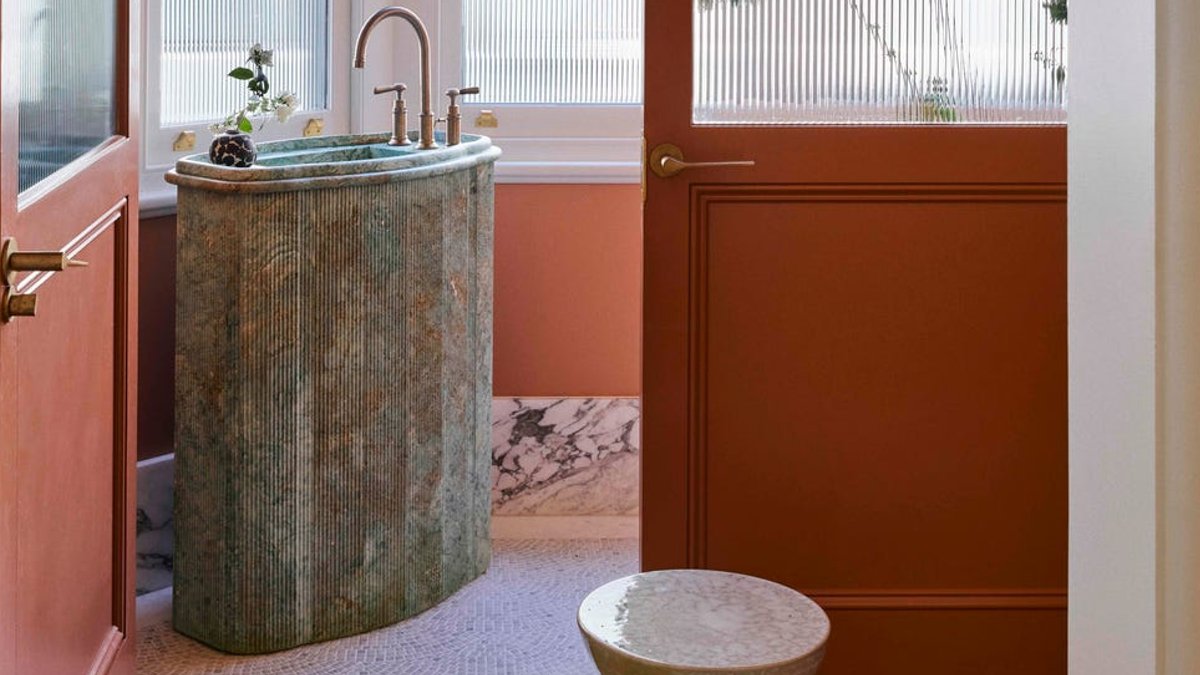
The choice of materials sets the tone for a bespoke vanity. The studio hand-carved accordion bands into the surface, refining a freestanding design that rises from a mosaic floor. Its undulating shape and bullnose edge reference classical detailing, yet the true impact comes from the unexpected harmony of color and texture within the space.
The studio’s approach emphasizes what they call “harmonious discord”—a principle guiding their material choices. In a Bondi Beach family home, Handelsmann + Khaw combined polished plaster with a blue-toned finish, creating a cohesive yet dynamic look. A fringed linen skirt softened the monolithic feel while concealing plumbing without restricting access. The result is a vanity that feels both sculptural and lived-in, with the contrast between plaster and fabric adding depth to the design.
Custom vanities increasingly reject standardized forms. A Child Studio project in a 19th-century London townhouse used Verde Guatemala marble, carefully carved to blend seamlessly with walls and floor. The flowing curves echoed the home’s softened geometry, while an oak-framed mirror hid full-height storage. Precision was critical—craftsmanship from an Italian marble workshop matched the exacting standards of Porto’s Villa Serralves, serving as a benchmark for the design.
Form Follows Function, With a Twist
Proportion often takes precedence over decoration in bespoke designs. Róisín Lafferty created a vanity for Colt Manor using Breccia Viola and Pernice marbles, their deep plum and burgundy tones complementing the Georgian heritage of the Irish estate. A brass frame anchored the piece, establishing it as the room’s focal point. The tilted custom mirror added dimensional depth, reflecting the space back upon itself, a detail that transformed functionality into an immersive experience.
In guest bathrooms, visual impact is essential. Leyden Lewis Design Studio designed a concrete vanity for a private residence, working with Trueform Concrete to pour a muscular form that adopted wabi-sabi imperfections. The piece was intended to oxidize naturally over time, creating a quiet sanctuary that grounded the space with tactile permanence. Unlike conventional fixtures, this vanity became an intentional element rather than an afterthought.
Scale influences how a vanity is perceived. YSG Studio addressed a compact Sydney bathroom with an oversized Crema Khrusos marble vanity, extending it to the floor on an angled plane. Recessed step detailing made the piece feel expansive without dominating the small space. The integrated basin maintained a streamlined appearance.
A standout concrete detail appears in a Paul Conrad Architects project, where Calacatta Viola marble’s burgundy veining was aligned to create the illusion of a single carved block. The vanity’s mirrored plinth lifted it visually, while a recessed tap preserved the surface’s continuity.
In an 11-bedroom East Hampton home, Bryan O’Sullivan Studio selected Patagonia Green marble for a guest bathroom, designing a console that appeared cleaner than traditional vanities. Polished-nickel hexagonal legs subtly referenced Sir Edwin Lutyens’ architecture, tying the piece to the home’s broader aesthetic. A niche between basin and mirror kept daily items accessible without cluttering the surface.
Practicality and aesthetics need not conflict. Studio Bosko lacquered oak in electric red for a Berlin penthouse children’s bathroom, pairing it with Brescia marble for contrast. The thick top layer and visible wood grain balanced playfulness with functionality, offering storage accessible to children while providing counter space for essentials. Trays organized toiletries into a neat arrangement, proving a clutter-free surface remains fully usable.
Placement and Spatial Integration
The positioning of a bespoke vanity can redefine a bathroom’s flow. At Arent Pyke, the turquoise granite vanity was placed near the entrance of a Federation-style powder room to optimize limited wall space. Its freestanding design allowed the mosaic floor and undulating form to merge seamlessly, reinforcing the room’s architectural unity. This approach ensures the vanity enhances rather than disrupts the space, particularly where wall-mounted options would feel restrictive.
Styling and Everyday Practicality
Even the most artistic vanities must accommodate daily use. Handelsmann + Khaw addressed this in a Bondi Beach home by incorporating a fringed linen skirt that hid plumbing while remaining accessible. The fabric’s texture softened the polished plaster’s rigid quality, proving that practical needs and visual appeal can coexist. A scalloped splashback further reduced visual clutter, keeping the vanity as a focal point without compromising usability.


