
Their work blends experimental thinking with material exploration, each bringing a unique perspective to furniture, textiles, and spatial concepts.
Henry Svendsen
For Henry Svendsen, the body is the starting point. “The body is the forefront; it is the starting piece,” he explains, emphasizing how his designs consider human interaction with objects and spaces. His architectural background at Nottingham University shaped this approach, evolving into sculptures and furniture that examine physical engagement.
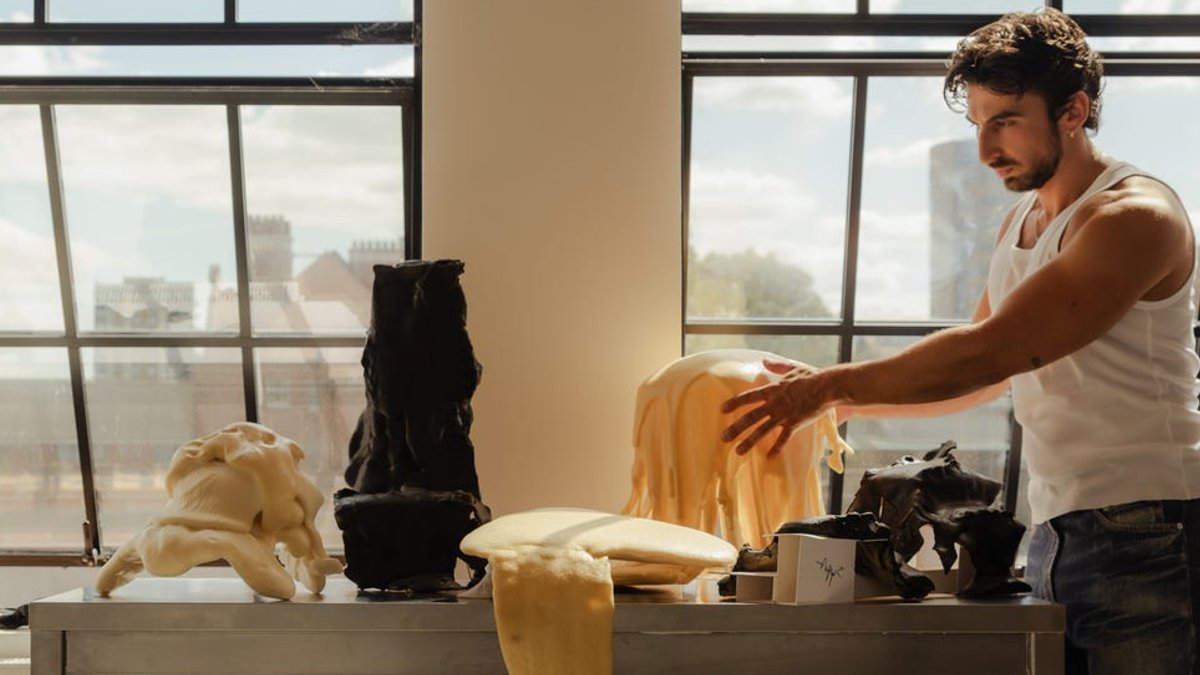
Svendsen’s debut collection, “Handle,” features tactile elements, bold silhouettes, and raw materials, evoking sensuality through metal and high-gloss leather. For the festival, he presents two new pieces at the VA Museum’s atrium, juxtaposed against classical statues. “It has the same palette – a high-gloss leather effect with the sterility of metal,” he says, noting the works’ organic, sculptural sensuality. Created in Deptford using poured polyurethane, the pieces draw inspiration from artist Lynda Benglis, exploring tension between object, space, and body.
Ruby Bowditch
A chance encounter at Kew Gardens sparked Ruby Bowditch’s award-winning design journey. “I was there for hours,” she recalls, sketching plants and architectural details during multiple visits. These drawings evolved into her final-year project, “Form and Foliage,” a textile collection winning the Robin and Lucienne Day Foundation prize. The seven-piece series combines detailed plant illustrations with brutalist geometry, achieved through laser-cut collage and screen-printing techniques for wallpaper and surfaces.
Bowditch credits her grandmother’s craftsmanship, sewing, crochet, and knitting, as her creative foundation. “My creativity is from her 100 per cent,” she says, laughing at childhood questions about becoming a “textiler.” An upcoming internship at Skinnydip signals growing industry interest, but her goal remains clear: launching a personal wallpaper collection under her own name.
Read Also: Cozy reading nooks to unwind
Jabez Bartlett
A need for a specific piece led him to create his first table, merging set design expertise with furniture innovation.
His work, characterized by ethereal forms and environmental reflection, has appeared at exhibitions like Basic Space and Alcova in Milan. The “001” table became a breakout piece, earning him a Forbes 30 Under 30 honor.
Emma Clarke
Emma Clarke’s studio explores material challenges through bold experimentation. Her glazed ceramic chairs test perceptions of fragility and strength. “When somebody approaches one of my ceramic chairs, they’re almost scared of its fragility,” Clarke explains, describing how visitors initially hesitate before discovering unexpected support. This tension between risk and resilience defines her approach to design.
Her work has since appeared in collaborations with Joy Objects and exhibitions across Europe.
Lorenzo McKechnie
Lorenzo McKechnie’s furniture roots trace back to childhood visits to his grandfather’s Italian workshop. “I have fond memories of running around with hammers in the workshop as a kid,” he recalls. Though he pursued other paths, a 2020 lockdown pause reignited his passion for making. “I needed new wooden climbing holds, so I started creating my own,” he explains, initially selling them online before transitioning to full-time design work. Self-taught through online tutorials and trial-and-error, McKechnie now crafts furniture using cherry wood from his family’s Tottenham timber yard and aluminum.


