
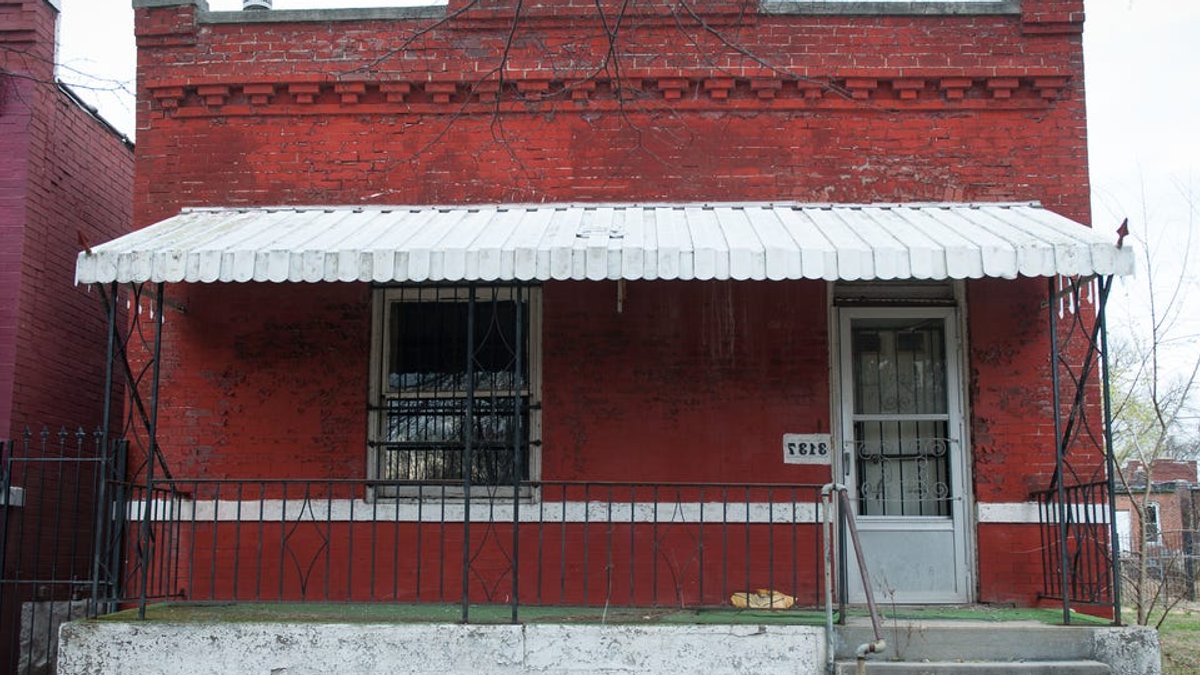
A modest red-brick house at 3137 Whittier Street in St. Louis holds a place in music history few buildings can claim. Built in 1910, the single-story cottage was home to Chuck Berry during the 1950s, the decade he wrote and recorded songs that defined rock and roll. From this unassuming neighborhood home, Berry composed hits like “Maybellene” and “Johnny B. Goode”, tracks that would later inspire artists from The Beatles to The Rolling Stones.
The house sits in the Greater Ville neighborhood, a historically Black area that served as a cultural center during segregation. Berry purchased it in 1950 for $4,500, sharing it with his wife, Themetta Suggs, and their growing family until 1958. The three-bedroom home was modest by today’s standards, one bathroom, hardwood floors, and a simple porch, but it provided the space Berry needed to craft his sound. In 1956, he expanded the house himself, adding a two-room concrete-block extension at the back. This renovation gave his family more room and created a dedicated space for rehearsals.
Berry’s basement became an informal studio where he refined his guitar riffs and lyrics, blending blues, rhythm and blues, and country into the energetic electric style that became rock and roll. His breakthrough came in 1955 with “Maybellene”, followed by classics like “Roll Over Beethoven” and “Sweet Little Sixteen”. These songs didn’t just sell records; they laid the foundation for a genre that would dominate global music for decades. Berry’s influence extended far beyond his own work; his guitar solos and storytelling techniques became templates for generations of musicians.
The Whittier Street home was recognized for its historical significance in 2008, when it was added to the National Register of Historic Places. Its preservation reflects both Berry’s legacy and the broader cultural impact of St. Louis’s Black communities during the mid-20th century. Nearby, other trailblazers like Tina Turner, Arthur Ashe, and Josephine Baker also left their mark on the neighborhood, turning it into a hub for music, sports, and the arts.
Berry died in 2017, but his former home remains largely unchanged from the outside. Original fixtures, including hardwood floors and plaster walls, are still intact, though the property has sat empty for years. In 2022, the St. Louis Development Corporation designated the house a priority for preservation, with plans to stabilize its structure and involve the community in future redevelopment. Recent work includes floor repairs and masonry restoration, though its long-term use has yet to be decided.


