
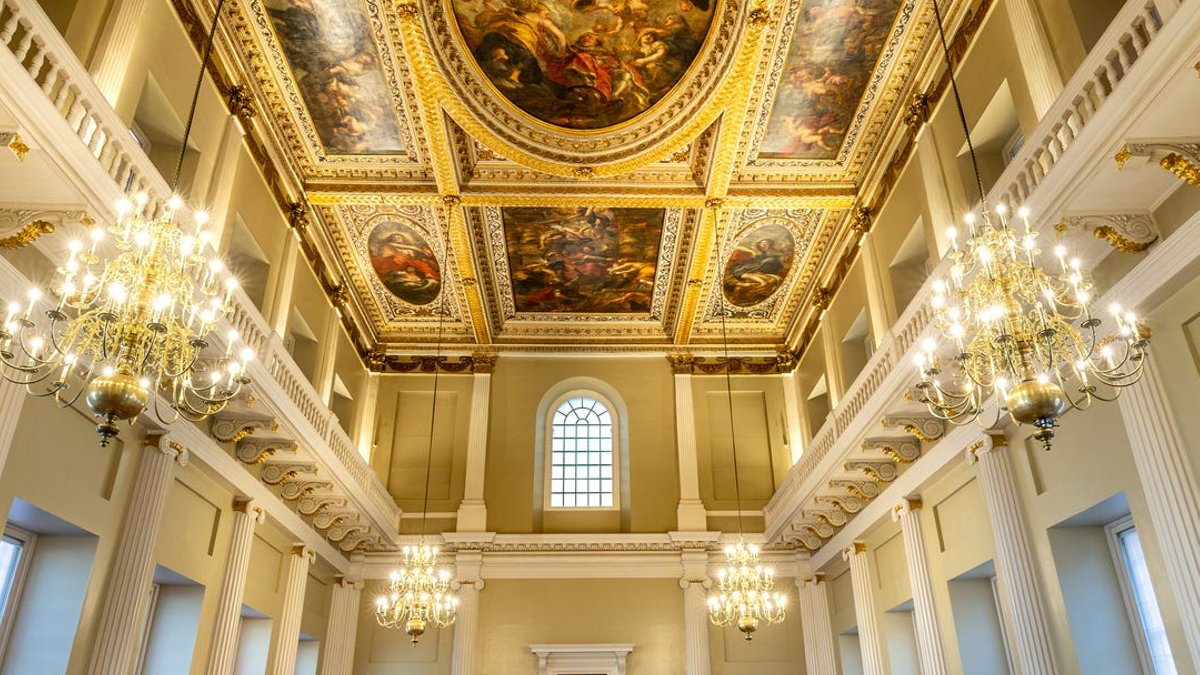
Central London’s Banqueting House stands as the last remaining piece of the once-vast Palace of Whitehall. This 400-year-old landmark preserves a key chapter of British royal history, showcasing classical architecture and art. Its most notable feature is a grand ceiling painted by Flemish Baroque artist Peter Paul Rubens nearly 400 years ago.
The Palace of Whitehall began as York Place, the London residence of the Archbishops of York. After Cardinal Thomas Wolsey fell from power, Henry VIII seized the estate and transformed it into a royal palace. It became the center for Tudor and Stuart court life, hosting royal ceremonies, political events, and entertainment.
The Architectural Vision of Inigo Jones
The building seen today was completed in 1622 for James I. It was the third banqueting house on the site, built to replace an earlier structure whose columns obstructed views of court celebrations. Architect Inigo Jones designed it, bringing Palladian principles of classical symmetry and proportion to English royal architecture.
Jones studied Roman and Renaissance buildings in France and Italy before applying his knowledge to Whitehall. The exterior originally used honey-hued and pinkish-brown stone with white Portland stone decorations. It received a uniform pale appearance after partial refacing in 1774 and a larger restoration starting in 1829, led by John Soane.
The main hall is a “double cube,” meaning it is twice as long as it is wide and tall. This open, balanced design encourages visitors to look upwards. Jones created the space for masques—elaborate performances with music, dance, and poetry—that honored the monarch and supported Stuart rule. A vaulted undercroft beneath the hall served as a private drinking den for James I and his friends.
Related Post: Five Young British Designers Shine at London Design Festival
A Ceiling Commissioned by Royalty
The most celebrated part of Banqueting House is its nine-panel ceiling, painted by Rubens. The idea began under James I, but his son Charles I officially commissioned the works in 1629 to honor his father and the Stuart dynasty. Rubens completed the paintings in Antwerp in 1634, and they were installed in 1636. He received £3,000 and a gold chain for the project.
The nine canvases cover more than 2,400 square feet. The three main panels depict James I uniting the English and Scottish crowns, ruling with wisdom, and ascending to the heavens. The other scenes use classical myths to reinforce the divine right of the Stuart monarchy. Jones designed the ceiling to fit the giant paintings, setting them into a carved, gilded wooden frame.
Banqueting House also marks a site of tragedy. On January 30, 1649, Charles I walked through the building to a scaffold outside for his execution following the English Civil War. He passed under the ceiling he had commissioned for his father less than 15 years earlier.
Today, visitors can experience Jones’s classical design, its gold details, and the Rubens paintings. Historic Royal Palaces opens the building to the public on select days; their website provides current opening dates, tickets, and visitor information.


