
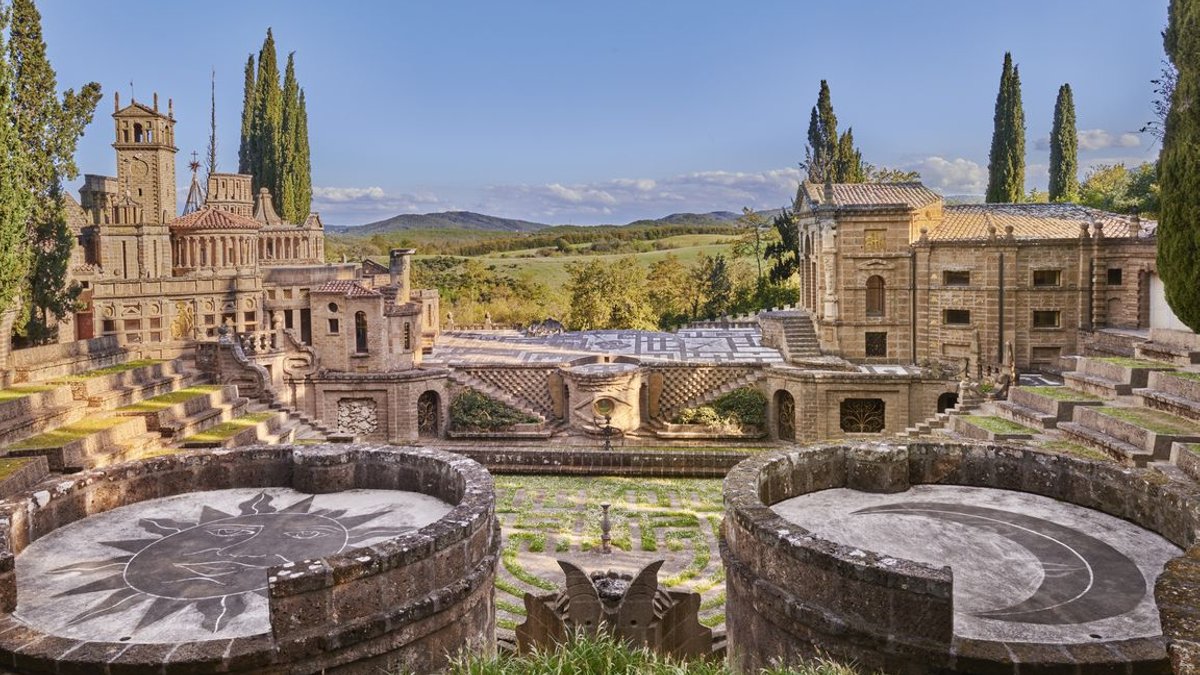
La Scarzuola, a sprawling complex in the Umbrian hills, is an autobiography in stone that visitors are told to enter with a different consciousness. According to Marco Solari, the site’s current guardian, guests must leave their everyday selves at the gate to handle the space properly. The property was purchased by Solari’s uncle, the Italian designer Tomaso Buzzi, in 1956, starting with a 13th-century church and convent founded by St Francis of Assisi. The story goes that St Francis planted a rosebush and a laurel, and when water surged forth, he took it as a sign of the place’s sacred energies. Named after the scarza plant, a marsh grass used to build his first shelter, La Scarzuola is Buzzi’s ideal city, the meeting of an erudite mind and a fertile imagination. Most of the construction occurred between 1958 and 1978, with Solari completing the work after Buzzi’s death in 1981.
Related: Italian Artist Quinto Martini Finds Riches in the Everyday
The Latin motto on the church façade calls the site an oasis of ‘absolute indulgence, a neo-Mannerist cornucopia of historical references, symbols and arcana sourced from classical civilisations and astrology, alchemy and theology. The bulk of the construction resembles a ship, aboard which visitors are invited to conduct a metaphorical navigation of the inner self. The belly holds a large amphitheatre with views across the Umbrian hills, the first of seven interconnected stages that proceed through the ‘anthill’, a riotous crowd of iconic buildings, some pristine, others in ruins. Replicas of the Colosseum and the Acropolis sit cheek by jowl with a triumphal arch, a Tower of Babel and a ‘pyramid’, which is really a fluted spire made of citrine-coloured glass housing a spiral staircase. The figurehead of the vessel is a monumental stone carving of a nude female torso, the standard-bearer for the feminine energy Buzzi felt running through the site.
Down a steep hill from the main structure lies an open-air corridor in the image of a sea creature in which, as Solari explains, visitors can experience ‘the dismemberment of the self’, a process recalling the three days and nights of reflection Jonah spent in the belly of the whale, before he was spat out into a new life. Buzzi conceived of his ‘Città Buzziana’ as an urban enclosure, whose energy and chaos would be tempered by the tranquillity of its natural surroundings. He built what was before his mind’s eye out of tufa stone from the nearby town of Viterbo. A porous rock produced by precipitations from water, the tufa at La Scarzuola was mostly carved into neat blocks, though some were left rough, giving the sense of an irrepressible life force frothing out of the walls. The esoteric attitude at La Scarzuola was inspired by the Hypnerotomachia Poliphili (1499), a book attributed to Francesco Colonna. Translated as ‘The Strife of Love in a Dream’, it follows Poliphilo’s romantic pursuit of his love Polia through a dream setting furnished with all manner of follies. The story was admired by the psychologist Jung, who recognised its dream imagery as a forerunner of his theory of archetypes.
Related: Dan Pearson designs for outdoor living
A garden of follies and reflection
At La Scarzuola, the evolution of the enclosed garden rhymes with an overt sensuality. Buzzi abandoned the hortus conclusus – the enclosed garden that also signified as an emblem for the Virgin Mary – for a more exposed and expressive kind of outdoor space. This shift is evident in his interpretation of the tale’s Cemetery of Lost Loves as a reflecting pond whose mirrored surface symbolises the meeting of male and female; or in the walled garden encircling the erect skeleton of a cypress tree, a masculine retort to the feminine figurehead steering the ‘ship’. While the site’s esoteric symbolism might seem distant from modern life, Solari insists that the entire complex is ‘at the service of the psyche; a place to uncover the infinite variations of the Self. With its emphasis on dreams and symbolism, and its immersion in nature, La Scarzuola resonates with contemporary sensibilities around self-enquiry, secular spirituality and a common desire to envisage new ways of life. As the old falls into ruin and alternatives remain scarcely visible on the horizon, the place offers people a chance to visualise what might come next, to complete Buzzi’s vision in the space of their own imaginations.
Related: Ishkar founders forgo ceilings in radical Columbia Road revamp
La Scarzuola, 05010 Montegabbione, Terni, Italy. For opening times and details visit: lascarzuola.it


