
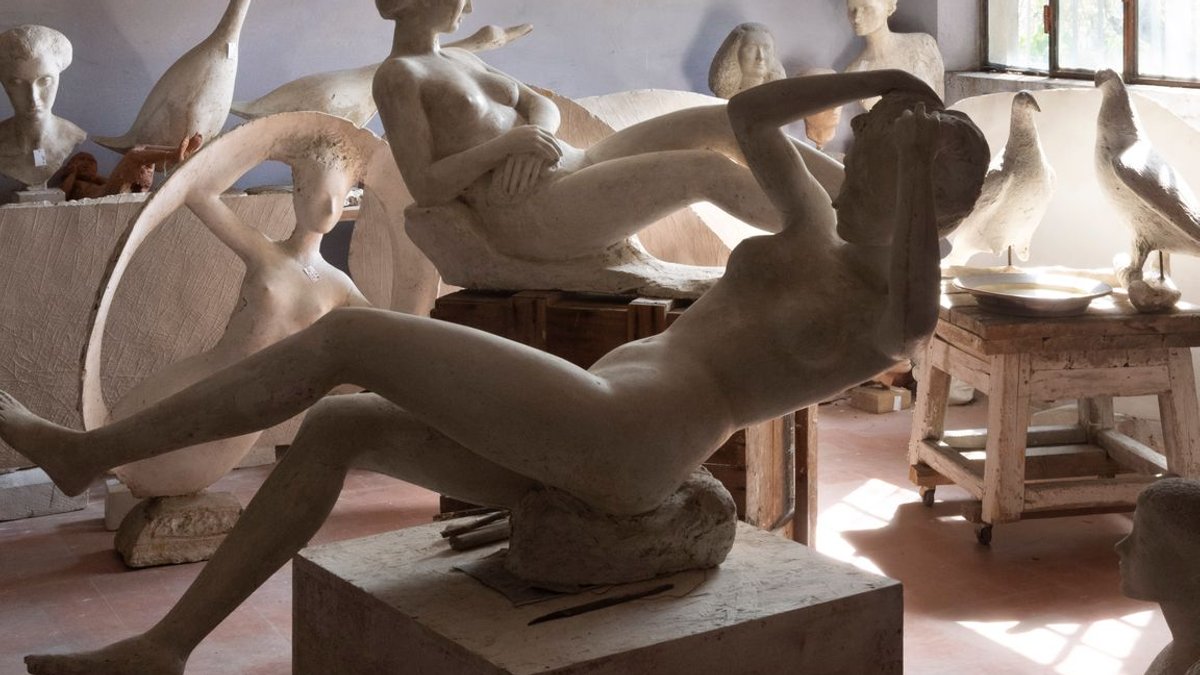
Italian artist Quinto Martini found riches aplenty in the everyday. While his contemporaries in Florence chased the idealized forms immortalized by Leonardo da Vinci, Martini focused on the rough-hewn reality of his rural surroundings. Hailing from the small Tuscan village of Seano, just miles from the Renaissance master’s birthplace, Martini spent decades improving the lives of ordinary people through sculpture and painting.
A life defined by the ordinary
Unlike Da Vinci, Martini had no interest in geometric perfection or ideal anatomy. His work celebrated the dignity of the working class and the natural world around him. This focus on “normality” became the cornerstone of his artistic philosophy. “I dislike any art that sounds of intellectualism and fashion,” Martini once said. “Instead, I love watching people and life.”
His commitment to social realism put him at odds with the political climate of his time. In 1943, authorities shut down an exhibition of his paintings, “The Beggars,” at Florence’s Lyceum. The regime viewed the unflinching depictions of poverty as a critique of their rule. Shortly after, Martini was imprisoned in the same cell once held by his older brother for anti-fascist activities.
Related: Eileen Gray’s forgotten Modernist gem revealed
Despite these struggles, Martini remained dedicated to his vision. He joined the post-war New Humanism movement, which rejected abstraction in favor of figurative art that served a social function. His sculptures captured the “simple vitality of this land,” a phrase he used to describe the people and places that inspired him.
A return to the farmyard
Although he spent much of his adult life in Florence, where he held the chair of sculpture at the Accademia di Belle Arti, Martini always wanted to return to his roots. After his grandparents died, he asked his relatives to leave him a small patch of land. “Sooner or later I’ll need to build myself two rooms,” he told them.
His brother, a bricklayer, built the house for him. The structure began as a single warehouse-like volume to store Martini’s archive. Over time, it grew into a simple home with a kitchen his nieces and nephews fought to host him in, a bedroom for his wife, and a studio filled with scale models and still-life paintings of flowers. The sitting room featured wide windows overlooking a patchwork of vineyards, cypress trees, and hills.
The local setting provided the primary inspiration for his work. Martini painted the changing weather and terrain repeatedly, yet he found endless variety in the people who lived there. His niece Stefania, who now oversees the Museo Quinto Martini, recalls visiting him. “Whenever I went to visit him, the first question he’d ask was, ‘What’s the weather like?'” she says. “And I always replied with the same thing: ‘How did you paint it?’
Related: Fix Your Showerhead for Just $2
It was the dignity of these rural residents that truly captivated him. Wandering through the sculpture park today, one sees the kind of figures that populated Martini’s life. There are women peeking from kitchen doorways and men in chef’s toques idling on chairs. The figures lean against walls with their eyes closed, appearing to take a brief respite from the weight of manual labor.
A legacy preserved in bronze
Martini’s home remains largely unchanged since his death in 1990. The floors in his studio are white with plaster dust, while the terrace is stained with paint. The upstairs room, where he sketched and wrote, is clean of marks. But Stefania says the memory of her uncle feels most alive in the sculptures scattered across the hillside.
The works capture a quiet dignity that requires no explanation. “The gaze moves from start to finish unhindered,” she says. “It finds nothing to get in the way – there is nothing more, just the essential.”


