
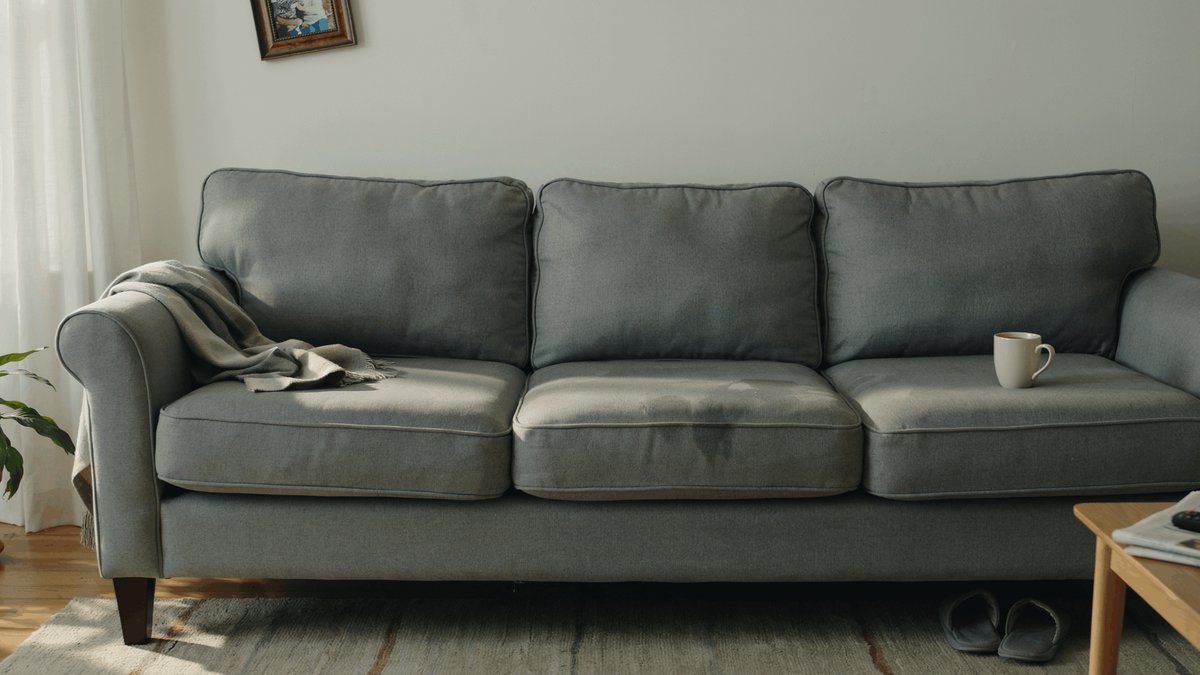
Your couch is only a few years old, but it already looks a decade older. One cushion sinks when you sit down, and the fabric on the usual spot looks faded and fuzzy while the other end still appears almost new.
Most sofas don’t wear out because they are cheap or old; they wear out because of daily use in the exact spot you sit, not due to fabric quality.
The fix is free and takes five minutes a week with items you already own, extending the couch’s appearance for many more years.
The test your couch was supposed to pass
Before fabric ever gets sewn onto a sofa, it goes through a machine built to wear it out.
Related: 25 Treehouse Designs For Kids Packed With Imagination
The furniture industry uses the Wyzenbeek test to measure upholstery durability. The Association for Contract Textiles describes the test as pulling a fabric sample tight and rubbing a rough pad back and forth across it, counting how many passes it takes before wear appears. One back‑and‑forth pass counts as a double rub.
The group sets 15,000 double rubs as the benchmark for normal home use and 30,000 for busy public places like hotels. Most couch fabrics achieve tens of thousands.
Even though a fabric survives tens of thousands of rubs in a lab, real‑world durability depends on many factors, especially cleaning and upkeep.
The lab test rubs the fabric with a clean pad, while a couch in a home is not clean. That single difference changes everything.
The real grinder lives in your cushions
Every day, tiny bits of dust, dirt, sand, and grit settle into a sofa. They ride in on clothes, feet, open windows, and the air, working their way into the weave and seams.
Related: Baron Palms Sharm El Sheikh Your Adult Only Paradise
Those particles do nothing while you sit without moving. The trouble starts the moment you press down.
Chelsey Byer, a family and consumer sciences extension specialist at the University of Illinois Extension, told Southern Living that weekly vacuuming or light brushing removes soil and protects the fabric from grit working between the fibers, which can increase abrasion and wear. Each time you sit, you press those hard little particles against the threads, grinding the fabric from the inside.
This is not merely a cleaning issue; it is the abrasion test running in your living room on the cushion you use most.
Wear appears unevenly because you sit in the same spot night after night, concentrating grinding in one area. Consequently, one cushion looks older, flatter, and duller than the rest while the far end still looks fine.
Why your favorite cushion caves in first
Sitting in the same place long enough causes the cushion beneath you to stop bouncing back; the padding becomes permanently squished.
Related: 25 TV Cabinet Designs Blend Function and Style
Thus, the two factors wearing your couch out are really one story: you sit in one place, grit grinds the fabric thinner, and foam loses its bounce. One cushion ages fast while the rest of the sofa coasts.
This is the most common way a couch ages, affecting almost every sofa that lacks a simple bit of upkeep.
The five‑minute weekly habit, start to finish
None of this requires money, special products, or muscle—just two small jobs once a week.
Vacuum the fabric and get into the seams. Run the brush or upholstery attachment over the seat, the back, and especially the cracks and seams where grit hides. The extension service recommends brushing or vacuuming upholstery about once a week to pull grit out before it can grind away at the threads.


