
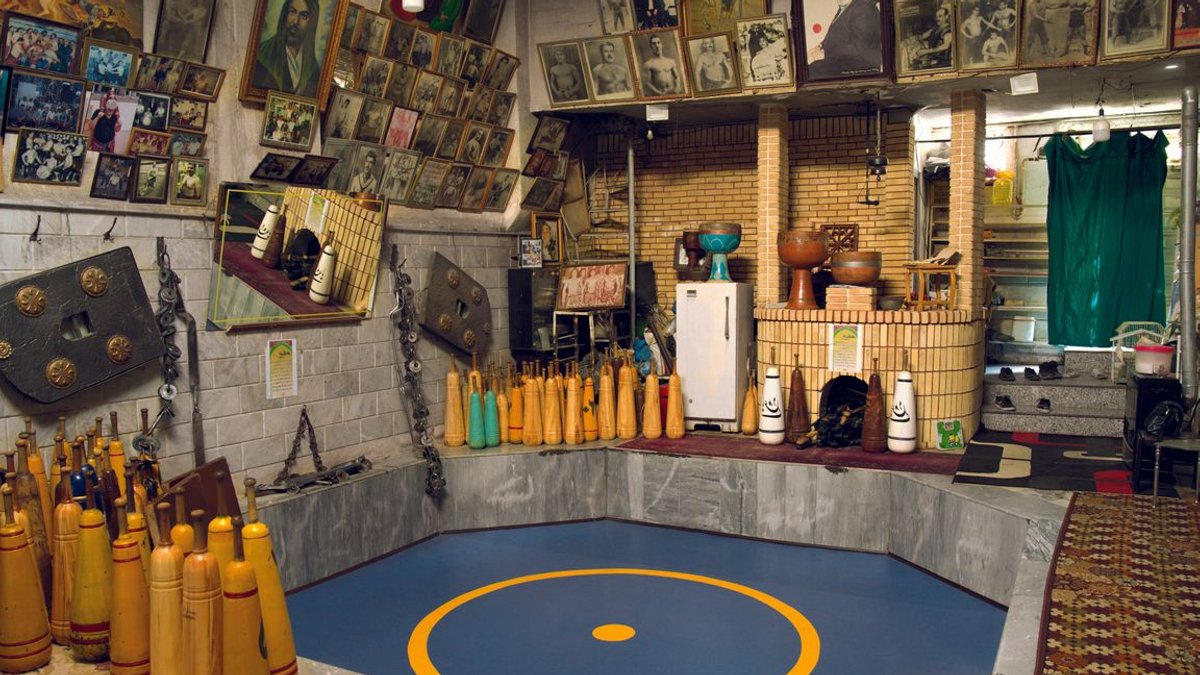
Zurkhanehs in Iran have served as centers for exercise, ritual, and community for centuries. The first thing visitors do on entering a zurkhaneh is step down. You descend a flight of stairs, before bowing your head to duck under a low doorway as a sign of humility. Inside, eyes are drawn towards the gowd, a sunken pit one metre below ground level. Around its edges, spectators sit on raised platforms looking into the octagonal stage below, where pahlevans (warriors or champions) move in circles to the beat of a drum. In this house of strength – the literal translation of zurkhaneh – the strongest bodies occupy the lowest point in the room.
For centuries these spaces have been a long-standing feature in cities and neighbourhoods across Iran, serving as places of exercise, ritual and community. Although it is difficult to pin down their exact origins, elements of pre-Islamic warrior culture, Sufi practice and later Shi’a traditions have all left their mark on the institutions that exist today. A zurkhaneh is not quite a gymnasium, though bodies are trained there. Nor is it a place of worship, though reverence hangs over its rituals. It’s not a theatre either, despite the audience that congregates around its perimeter, or the highly choreographed nature of the routines performed within the gowd. Collectively known as varzesh-e bastani, or ‘ancient sport’, these exercises occupy an unusual position somewhere between athletics and performance.
Participants move around one another, following techniques, rhythms and sequences that have changed little across generations. Contemporary gym culture fragments bodies into isolated acts of self-improvement: one person lifts, another fights for their life on a Stair Master, someone else pedals through a virtual forest on a stationary bike. The zurkhaneh, by contrast, gathers bodies together (usually male bodies, though this has shifted in recent decades, with some welcoming female visitors or holding dedicated women’s sessions). Above the arena sits the morshed, or guide, who typically presides from an raised platform known as the sardam, often the most decorated area of the room, positioned to overlook both the athletes and spectators.
Related: Bozeman gets new eco friendly neighborhood development
When an important person or athlete enters, the morshed rings a bell. Working with the miyander, a senior pahlevan who leads exercises from the centre, he recites poetry, prayers and passages from Persian literature while striking a zarb, a goblet-shaped drum. The recitations do more than keep time; they reinforce the ethical principles of javānmardi, a philosophical concept loosely linked to chivalry, which emphasises humility, generosity, self-discipline and service to one’s community, reminding participants that strength is measured as much by character as physical ability. Movements follow the pace of the drumbeats, relying less on counting sets than the rhythm of the morshed’s recitations. Zurkhanehs often occupy domed or vaulted interiors, the centre aligned precisely with that of the gowd, amplifying the percussion and prayers so that they resound around the room.
Resting against walls or stacked around the edge of the central pit are the tools for which these places are best known. Meels, huge wooden clubs carved from elm or pear wood, evoke ancient maces and are swung behind each shoulder, one after the other. Wooden boards, called sang – meaning ‘stone’ and referring to the original material used to create shields – are used for a type of push-up manoeuvre. The kabadeh, an iron frame supporting a series of chain-linked metal rings, echoes the shape of a warrior’s bow, rattling as the participant brandishes it above his head.
The movements hark back to battles, epics and ideals of heroism that belong as much to mythology as to history. Persian rugs soften the perimeter of the gowd, while sofas and coffee tables occupy corners of the room alongside trophies and exercise equipment. This arrangement might seem unusual in a gym, though less so in Iran, where the gravitational pull of a handwoven carpet and somewhere to sit for a chinwag is always strong. Few figures appear more frequently in the visual culture of the zurkhaneh than Rostam, the mythological hero of Abual-Qasim Ferdowsi’s epic, the Shahnameh: his feats of strength have shaped Persian ideals of courage and masculinity for centuries. His image shares space with references to Imam Ali, regarded as an embodiment of both physical power and virtue, and portraits of celebrated pahlevans, particularly those specific to places they trained. Furnished too with trophies and decorative objects, the room is an informal archive of the communities that sustain it, ensuring that no-one trains alone.
Related: Hope Ranch Estate: A crafted sanctuary of peace
In the West, modern fitness is introspective (god forbid you forget to bring your headphones to a workout). It centres on self-optimisation and personal transformation, with floor-to-ceiling mirrors that are impossible to escape, multiplying the body back to itself. Mirrors can be found in zurkhanehs, of course, ensuring postures are correct and to create the illusion of space. Yet unlike contemporary gyms, attention is directed towards the collective rather than the self. Participants move in unison, following the rhythm set by the morshed and the miyander. Pahlevans remain constantly aware of those around them, and the audience too forms part of the overall choreography. Exercise is never entirely private – the body exists in relation to the surrounding community. Older generations return to watch from the raised seating that surrounds the gowd, while children observe the routines they might one day adopt.
This symbiotic relationship is reflected in the architecture itself: the lowered arena, the raised sardam and the seating levels that ensure everyone in the room occupies a clearly defined role. Even after centuries, the first lesson of the zurkhaneh remains architectural in character: before strength comes humility.


