
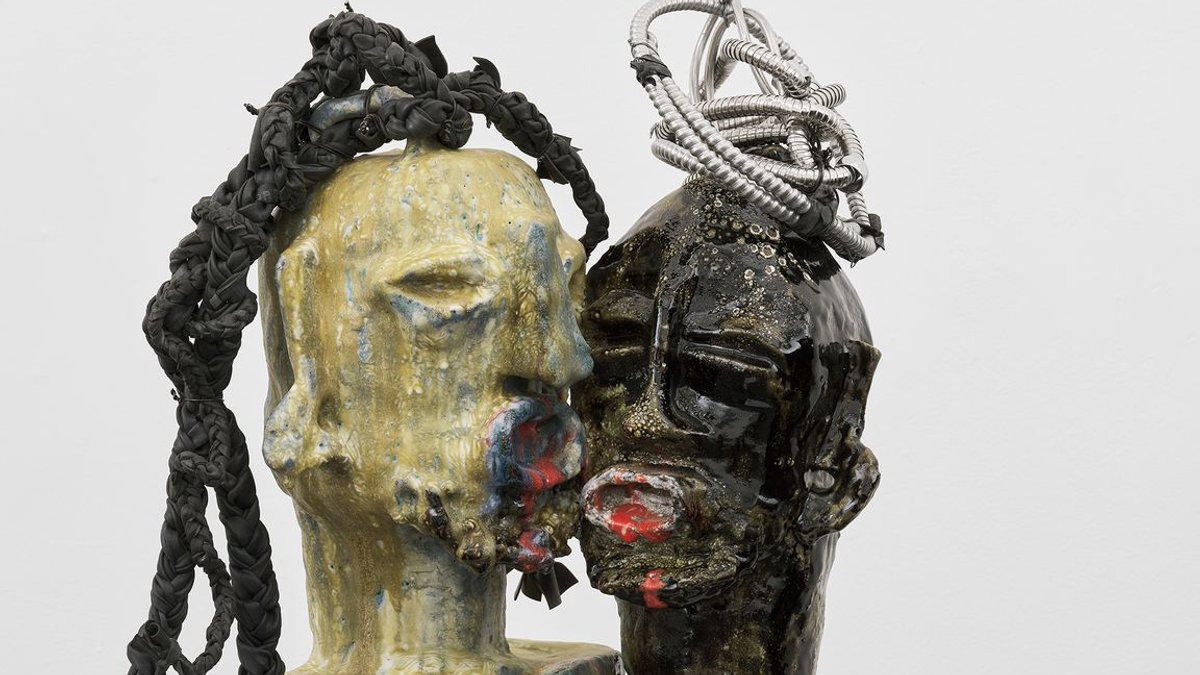
Leilah Babirye’s new show at the ICA Boston, Leilah Babirye: Embaga ya Naki ne Naki (Wedding of Naki and Naki), brings the artist’s imagined queer clans to life through a mix of ceramics, wood, metal and reclaimed objects.
From exile to exhibition
Born in Uganda in 1985, Babirye grew up in a large family before being forced to leave her home after being outed as a lesbian in 2015. She says the Ugandan term for gay people, “abasiyazi,” likens them to a part of sugar‑cane husk that “not even insects feed upon.” After fleeing, she settled in New York, where she began salvaging discarded materials from the streets.
Those scraps—bicycle chains, tangled wires, even inner tubes—are reshaped into crowns, earrings and hair for the stoic figures that dominate her work.
Related: Unique library showcases hundreds of paintbrushes
The sculptures echo ancient African masks, yet their faces are closed, lips pursed, conveying a calm that recalls deities whose authority is unquestioned. Each piece is accompanied by a fabricated origin story, placing the figures within imagined queer lineages that belong to traditional Ugandan kingdoms. In doing so, Babirye carves a legacy of queer ancestors and elders into the visual culture of the continent.
What the exhibition presents
At the ICA Boston, the installation stages a same‑sex wedding with a ring‑bearer, a flower girl, a bridesmaid, a bride and a groom arranged in a festive tableau. One of the highlighted works, Tuli Mukwano (We Are in Love) III (2025), depicts two lovers brushing cheeks, their faces rendered in earthy brown and green glazes. Bicycle inner tubes are twisted into a snaking bun on the left‑hand figure, while a coarse braid falls from the right‑hand figure’s head, their lips turned toward each other in an intimate gesture.
The exhibition arrives amid a national climate where marriage equality faces new challenges and anti‑trans healthcare bills are being passed. The work frames queer rituals as celebratory and sacred, offering a visual affirmation of the joy and love that bind these communities.
“I am creating my own family, reaching my own people, and honoring my community,” Babirye says, noting that she has never attended a wedding like the one she portrays. The show therefore becomes a personal declaration of freedom, a place where she can inhabit the society she imagines.
Related: McAlpine estate sale fetches high prices
From a broader perspective, the show highlights how contemporary art can serve as a form of cultural documentation. By embedding queer narratives within traditional aesthetic forms, the artist not only preserves but also expands the visual language of African art, inviting viewers to reconsider whose stories belong in the canon.
Visitors to the ICA Boston can see the installation until 18 January 2027. The museum’s website provides additional details about the show’s schedule and related events.
It ends soon.


