
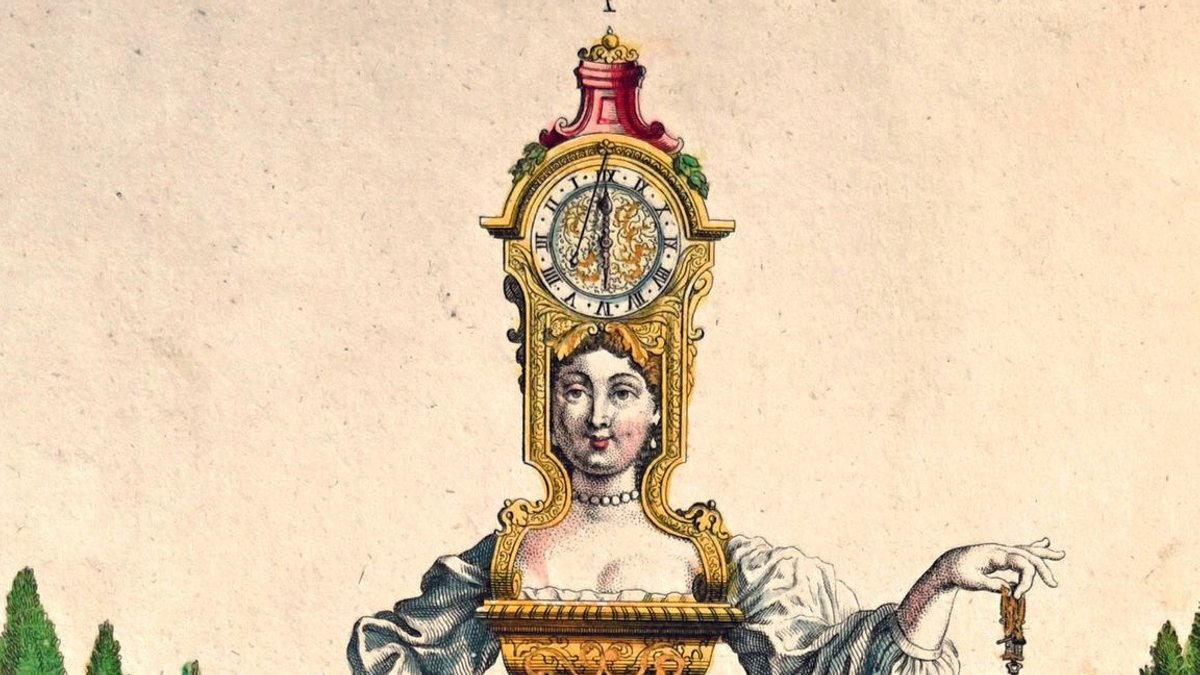
In the early 1730s, German engraver Martin Engelbrecht created a series of 84 hand-colored prints that turned professions into wearable absurdities. Each design transformed workers into living caricatures of their trades—bookbinders draped in book covers, butchers wrapped in cowhide, fishwives accessorized with eels and lobsters.
The prints show figures whose clothing isn’t just functional but a literal extension of their work. A female bookbinder wears a hoop skirt stitched from book spines, while her male counterpart sports a hat shaped like a book press. The butcher’s coat includes the full head, hooves, and tail of a cow, and his wife is draped in raw meat, an idea that would later inspire Lady Gaga—though three centuries earlier.
Theatrical origins, uncertain purpose
Engelbrecht, a prominent printmaker in Augsburg, produced miniature theaters and detailed engravings. His pieces frequently experimented with depth, such as scenes viewed through a zograscope—a 18th-century optical device that enhanced flat images. These costume designs, however, stood apart.
Fantine Bellanger, of the Librairie Camille Sourget in Paris, which recently acquired a full set, explains that intact collections are rare. “Individual sheets were often removed and framed separately,” she says. “It’s easy to imagine a lute maker buying just the print of his trade, but the series loses something when broken up.”
Related: Fix Your Showerhead for Just $2
Satire, spectacle, and the art of excess
The engravings drew inspiration from Nicolas de Larmessin’s Costumes Grotesques of the 1680s, though Engelbrecht’s versions were far more elaborate. Larmessin’s figures resembled periwigged versions of the Tin Woodman, while Engelbrecht’s designs adopted the Rococo’s love of decoration. “If Larmessin invents the genre,” Bellanger says, “Engelbrecht turns it into something closer to a stage performance.”
At a time when sumptuary laws dictated attire based on class, Engelbrecht’s designs pushed the idea to extremes. Guilds once made professions instantly recognizable—bakers in white, butchers in aprons—but by the 18th century, those distinctions were fading. His prints mock the notion that clothing alone could define a person’s role, even as they celebrate its absurdity.
Today, complete sets are rare. Most survive as single sheets, framed and displayed alone. When found intact, the full collection feels like a deck of cards—each profession a character, the set a game of visual humor. Engelbrecht’s work shows that clothing has always been more than fabric. It’s a performance, a statement, and sometimes, a joke.
For those interested in unconventional design, Engelbrecht’s prints echo the bold choices seen in recent architectural experiments that challenge traditional boundaries.


