
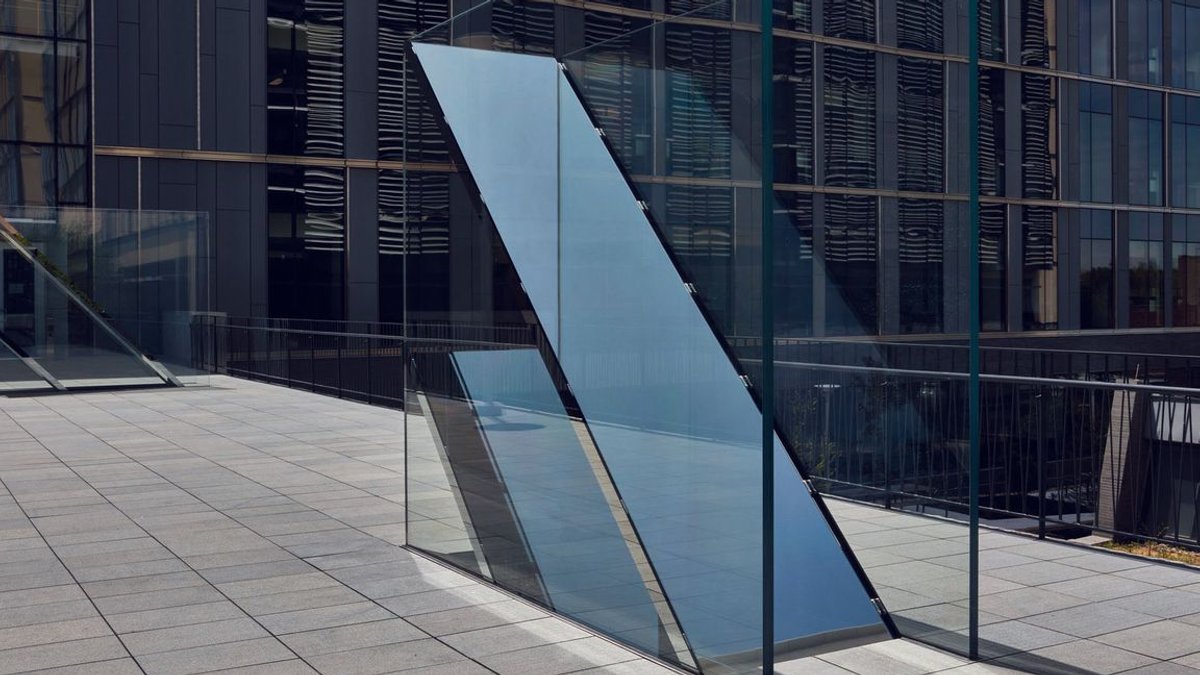
Sarah Oppenheimer’s sculpture C‑010106 has become a quiet focal point on the University of Texas at Austin campus, drawing visitors who otherwise might pass the new bridge without a second glance.
How the installation appears
The work sits atop an raised pedestrian bridge built in 2021, a structure of glass, steel and limestone that connects newer engineering buildings. At first glance the piece resembles a pair of metal‑clad phone booths or a functional support, but its true form emerges only when a viewer looks closely.
By moving around the installation and peering into its wide opening, the observer could see “myself standing in a rectangle of sky” with an “early moon, upside down.” The effect, created by angled mirrors and transparent panels, turns ordinary surroundings into a distorted, almost surreal tableau.
During sunset, the glass catches the changing colors of the sky, casting rainbows across the bridge. Bike racks beneath the structure are multiplied by the mirrors, forming “slightly kaleidoscopic shapes.” The viewer’s head can slip into one of the openings, revealing a “rectangular slice of a building” that appears to float against a deep blue backdrop.
Related: 19th-century Swedish estate celebrates architecture and sea
Visitor experience and impact
It invites repeated visits, each time offering a new visual twist as the angle of the sun shifts.
Visitors describe the experience as “playful,” noting how the mirrors make “the ground where a wall should be” appear, and how “people where there should be air” seem to materialize.
The sculpture, described as Oppenheimer’s first public‑space design, serves as a “glorious antidote” to routine walks, providing a moment of surprise in an otherwise orderly environment.
From a broader perspective, such installations illustrate how art can reshape everyday infrastructure, turning a simple crossing into an interactive visual experience that encourages people to pause and look.
Related: Blake Centre Honours Illustration Art
Visitors often pause to look.
Context within the campus setting
While the surrounding campus features a mix of historic stone buildings, old trees, and newer glass façades, C‑010106 stands out for its ability to merge function and aesthetic. The piece does not serve a structural purpose; it exists purely as an artistic intervention.
Its presence has sparked informal conversations among passersby, who often remark on the “shimmery prisms” and the way the work “multiplies” ordinary elements like bike racks. The design—two mirrored sections that frame the sky and surrounding architecture—creates a sense of depth that can be “almost like jumping and flying into space.”
Overall, Sarah Oppenheimer’s C‑010106 offers a subtle yet striking reminder that everyday spaces can host moments of visual wonder, inviting campus members to see familiar surroundings in a new light.


