
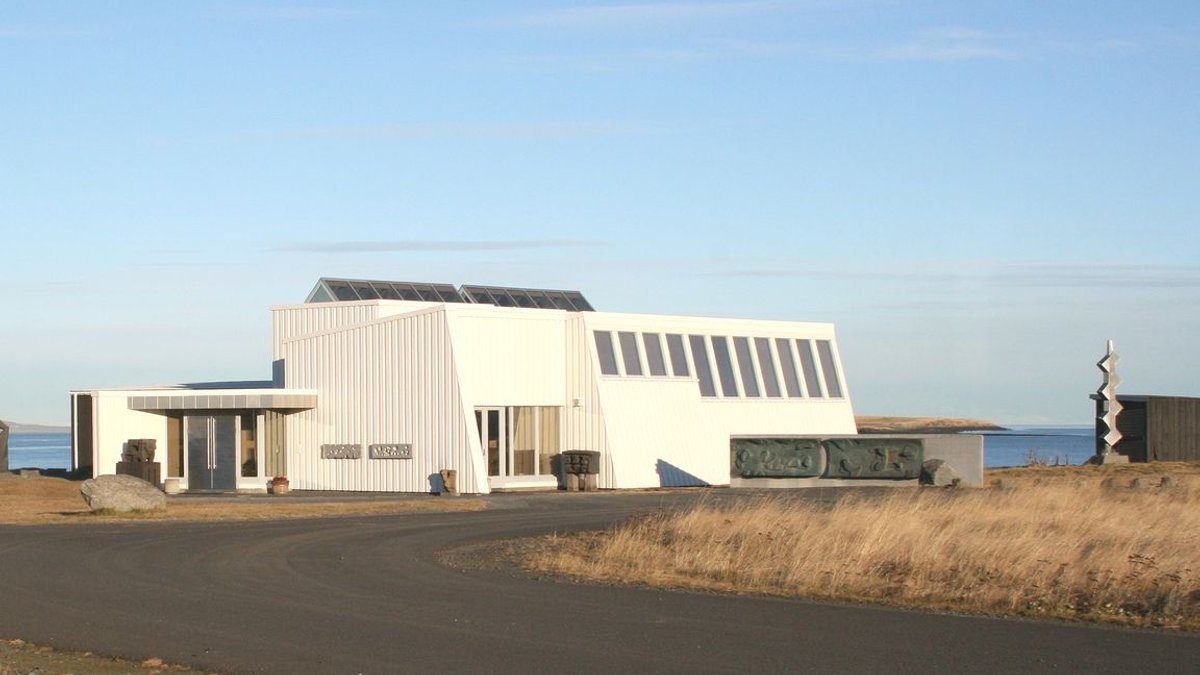
The Sigurjón Ólafsson Museum, perched on Reykjavík’s Laugarnes peninsula, preserves the legacy of one of Iceland’s most influential 20th‑century sculptors.
From military hut to artist’s studio
The site began as a military pharmacy housed in a corrugated‑steel Nissen hut. In 1945, sculptor Sigurjón Ólafsson (1908‑1982) started converting the complex for his own use. By the 1960s he enlisted Icelandic architect Skarphéðinn Jóhannsson to design a modern timber studio and an adjoining extension.
When Ólafsson died, his widow Inga Birgitta Spur took responsibility for the collection, which exceeds 200 pieces. She hired Ögmundur Skarphéðinsson, the architect’s son, to adapt the property into a public museum. The renovation, completed in 1988, painted the studio white, highlighting its geometric shape, and added a gallery and café where Spur bakes cake.
Related: Paul Smiths peaceful London home retreat
Life inside the museum
Spur, born in Denmark in 1931, studied at the Danish Royal Academy before meeting Ólafsson at age 18. She apprenticed in his Copenhagen workshop, learning to build scaffolds for large clay works. After marrying the artist and moving to Iceland in 1956, she raised four children while supporting his practice.
Today she lives in the adjoining house, surrounded by the sculptor’s abstract works. In a Siberian‑pine living room, a picture window frames the sea, casting shadows across yellow curtains. A mixed‑material sculpture of wood, iron and copper twists in the light. “It has so many layers,” Spur says, noting that the piece reflects Ólafsson’s search for expression and invites viewers on their own artistic expeditions.
Spur believes that when an artist “knows what they want and who they want to be, they’re static, they’re resting, they’re not pushing.” Her daughter, violinist Hlíf Sigurjónsdóttir, adds that her father “didn’t want to be popular, because God forbid he would have to repeat himself.” The family’s memories include handmade clothing, fishing for food, and an unconventional lifestyle that set Ólafsson apart in Icelandic society.
Related: Autobiography in Stone: The Enigmatic La Scarzuola
The museum opened to the public in 1988.
Ólafsson’s career spanned Denmark and Iceland. He studied and worked abroad from 1928 to 1945, interacting with figures such as Asger Jorn and Finn Juhl. In Denmark he earned the Eckerberg medal for portraiture in 1939 and designed a children’s house for Tivoli Gardens that was never built.
Returning home after World War II, he found Iceland’s artistic infrastructure limited; the nation’s first art school opened only in 1939, and sculpture remained a marginal discipline. Nonetheless, he contributed public works, including a 1966 relief for the Búrfell hydroelectric plant, and sustained himself through realistic stone and bronze portraits of cultural leaders.


