
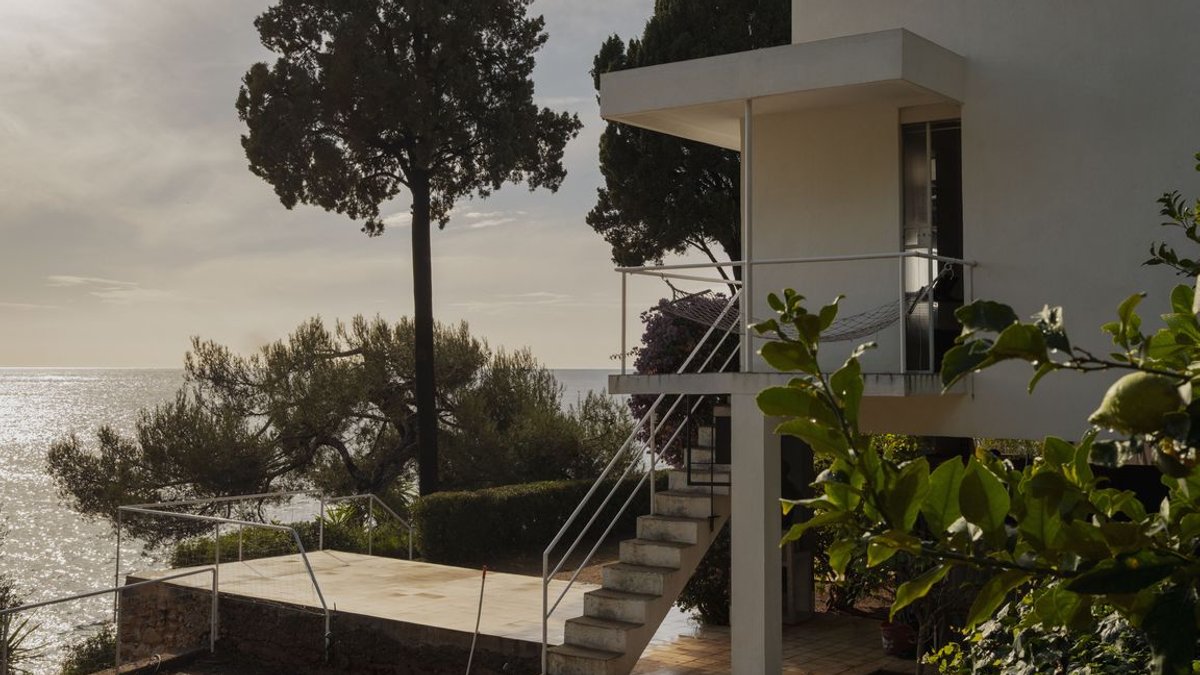
The white house clings to a rocky outcrop at Roquebrune-Cap-Martin, where the Mediterranean gnaws at its foundations. Over the decades, it has endured squatters, storms, a murder in the 1960s, and German soldiers who used its walls for target practice during World War II. The most deliberate violation occurred in the 1930s, when Le Corbusier painted eight murals across its interiors—works some critics now consider an act of architectural vandalism.
The house that defied Modernism
Completed in 1929, E-1027 was the first full building designed by Eileen Gray, an Irish architect and designer. She had spent years crafting lacquer screens, rugs, and lamps before turning to architecture at 50. While her furniture—like the Bibendum and Transat chairs—became design classics, the house remains her masterpiece.
At first glance, it fits the International Modernist style: flat-roofed, raised on pilotis, with flexible interiors. Gray’s approach went beyond the movement’s austere rules. She designed the house with—and for—her lover, the Romanian architect Jean Badovici, yet it rejected conventional domestic spaces. Gray eliminated gendered rooms like studies or boudoirs, favoring fluidity instead.
Adjustable tables, a Satellite mirror, and a breakfast tray designed for bed-bound meals prioritized comfort. A Baudelaire quote from Les Fleurs du Mal adorned the central wall, referencing the “femmes nouvelles” and the queer desire of her circle.
Related: Satoshi Kondo revives Miyake plastic bustiers in washi
A refuge for the “new woman”
Gray’s work emerged from a Left Bank milieu where women redefined art and identity. Gertrude Stein explored same-sex relationships in her writing. Romaine Brooks painted androgynous figures in muted tones. Natalie Clifford Barney hosted salons where Sapphic experiences were discussed openly. Gray’s interiors for E-1027—sensual and tactile—stood apart from Le Corbusier’s minimalism. He once dismissed such decoration as excessive.
Where Le Corbusier saw a “machine for living,” Gray envisioned a living space that adapted to its inhabitants. Her philosophy treated architecture as an extension of the self. The murals he later painted, though technically skilled, clashed with her vision. For Gray, the house was a sanctuary where identity could unfold freely.
The murals remain a permanent tension between two visions of Modernism. The building still stands, though its survival has been fragile. After decades of neglect, a restoration in the 2010s stabilized its structure.
Her approach to furniture also left a lasting mark. The Bibendum chair, with its playful curves, remains a symbol of functional elegance.


