
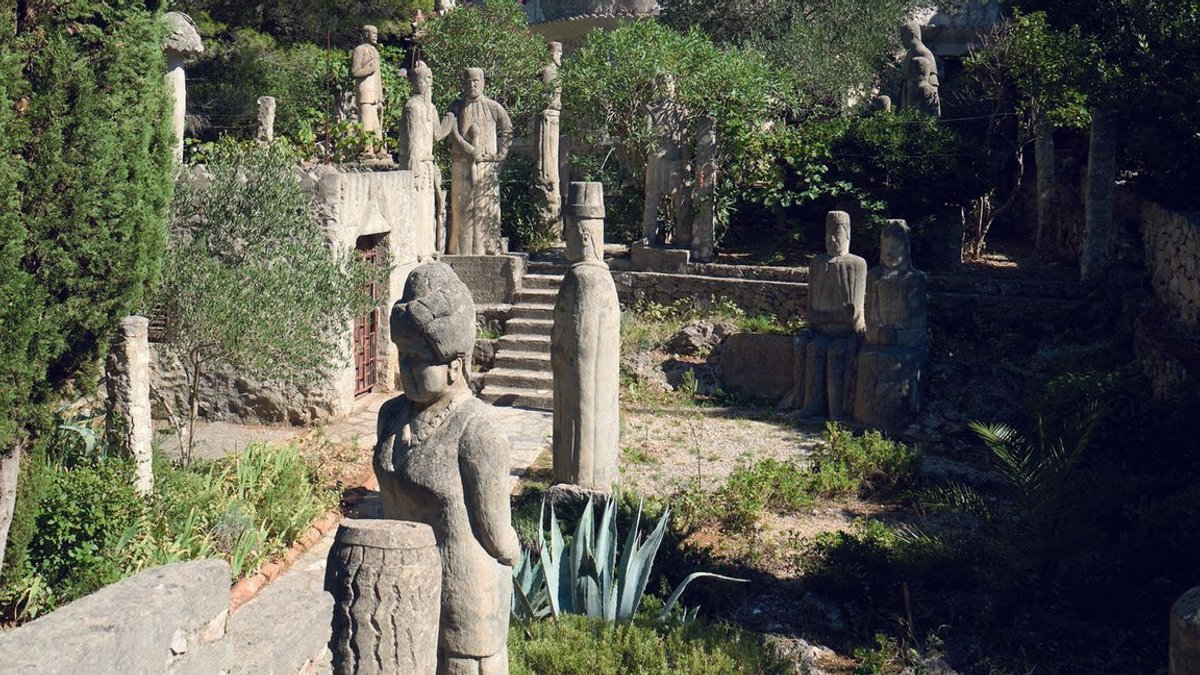
On the island of Ugljan, off the Dalmatian coast, lies a unique retreat that blends Brutalist and Medieval styles, created by Croatian outsider artist Emilan Grgurić. The Garden of Eden, a lush sculpture park, and the villa at its heart are a startling anomaly among the crystal-blue waters and quaint villages.
Emilan was born in 1919 in Januševac, near Zagreb, and was an economist by trade, but a creative at heart. He dedicated his life to making his artistic vision a reality, despite growing up poor with a strict father who didn’t allow him to nurture his talent.
In the early 1960s, Emilan found an untouched plot of land on the island, which could only be reached by boat, and decided to build his sanctuary there. The first thing he tackled was the house itself, Villa Katarina, named after his mother, which has a strange organic quality to it, evoking a massive beehive.
The house’s highest gable is topped by a concrete bust of Katarina, watching over it like a patron saint. According to his daughter Dunja, the whole project stemmed from Emilan’s grief over losing his mother at the age of 12, and he even hid a lock of her hair in the concrete head.
Related: Blake Centre Honours Illustration Art
The walls and ceilings of the house are covered in concrete reliefs on monochromatic red, green, or blue backgrounds, creating a visual turmoil that is hard to comprehend at first. The iconography is varied, with scenes from the Bible, as well as the glorious past of the Croatian people and historical injustices they felt.
Emilan claimed that the main theme of his art was the exploitation of the common people through time. His daughter Dunja explains that he wasn’t particularly religious, but his vision of God was incorporated in a larger philosophy of life, its beginning and its end.
Emilan’s wife often participated in the execution of his ideas. Dunja remembers her helping build the house: there was no-one else around to lend a hand. Together they worked ‘without electricity or running water, with nothing but lime, sand, cement, water and a sifter’. But Melita’s greatest contribution to her husband’s magnum opus was the setting: it was she who planted
The house and the garden are closed to visitors, and Dunja is now trying to preserve her father’s legacy and repair the damage, though she is in her seventies and lives far away.
Related: Hope Ranch Estate: A crafted sanctuary of peace
They are slowly returning to nature. As Dunja works to preserve her father’s work, it’s clear that his legacy is not just a collection of sculptures and a house, but a reflection of his love for the island, its inhabitants, and the world at large.
Emilan’s story serves as a reminder that art can be a powerful tool for expression and preservation of cultural heritage, and that the passing of time can be both a creator and a destroyer of beauty.
Dunja’s efforts to preserve the garden and villa are a sign to the enduring power of art to bring people together and transcend time.


