
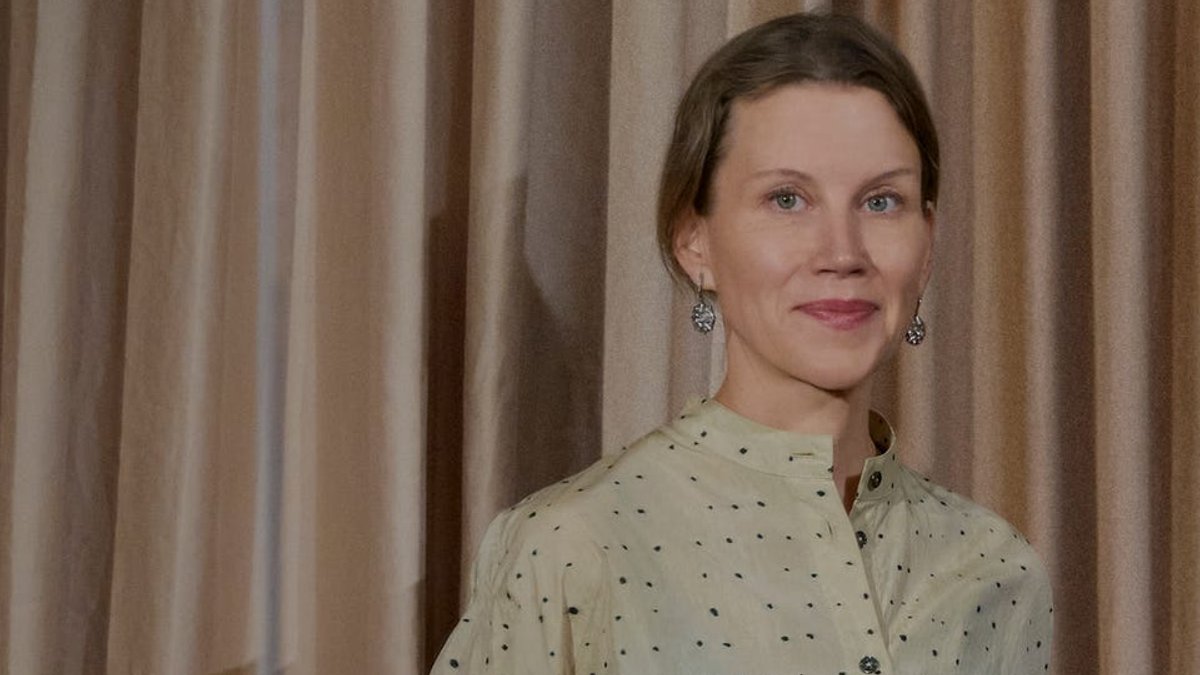
Silka Rittson-Thomas has spent nearly two decades defining the overlap between art and design, but her latest endeavor represents a notable transition into retail. As a curator and advisor with a background in galleries, auction houses, and the Positano residency program, she has now created the first permanent flagship for Le Monde Béryl, a luxury footwear brand established in 2016. Located on Manhattan’s Upper East Side, the store is a joint effort with architecture studio Tutto Bene, merging Renaissance-inspired elements with contemporary luxury. Inside, Murano glass sconces cast light alongside aluminum chairs designed by Mats Theselius, while a custom Ransom Dunn sofa anchors the space.
The design reflects Rittson-Thomas’s signature approach: dramatic yet meticulously controlled. “On the one hand I was thinking about the principles of the Renaissance, specifically around lighting, reflections and proportions, while the idea was to create a space which feels theatre-like, a place of discovery,” she says. The restrained color palette avoids conventional retail aesthetics, instead evoking the intimacy of a private gallery or salon. The outcome aligns with her broader curatorial practice, where commerce and art converge without compromise.
This is not the first time she has explored unconventional environments. In 2015, she launched an art residency at Le Sirenuse, a historic hotel in Positano, where hospitality and creative collaboration merged. Now, she is applying that same philosophy to retail, demonstrating that even footwear can embody artistic intention.
Art, time, and the objects that endure
Rittson-Thomas’s design principles stretch beyond commercial work. She gravitates toward eras that balance order and erosion—Neoclassicism, the 1930s, Brutalism, and weathered architecture—where materials accumulate meaning over time. Among her favorite structures are a 1970s modernist bungalow owned by her parents, geometric gardens by Fernando Caruncho, and the Ibn Tulun Mosque in Cairo. Even furniture becomes a subject of study: she admires Cy Twombly’s elongated Roman sofa as much as a weathered Kaare Klint design. “I have a tendency to consider sofas as objects rather than objects of comfort,” she notes, a perspective that extends to her curatorial choices. Whether selecting art or designing interiors, she seeks equilibrium between form and purpose, even when the result defies expectations.
Related Post: Five Young British Designers Shine at London Design Festival
Her influences span disciplines. The natural world, artistic processes, and the interplay of light all shape her vision. Her preferred galleries are primarily in London, where she values the city’s dynamic, experimental scene. Names like Emalin, Heidi, and Edel Assanti highlight her preference for both emerging and established artists. Among her favorites are Joan Mitchell and Simone Fattal, with a particular affinity for works that blend abstraction with craftsmanship. A Zurbarán rose or a 1960s Jannis Kounellis painting might appear in her collection, but she also admires contemporary ceramics by Milena Muzquiz.
From vintage treasures to future collaborations
Rittson-Thomas’s personal collection features vintage treasures, including an 18th-century Sicilian Baroque mirror with turquoise accents and Viceregal Peruvian bureau-cabinets inlaid with mother-of-pearl. These pieces reflect her reverence for history embedded in objects. Yet her work remains forward-looking. She is currently renovating a London apartment with Tutto Bene and collaborating on a “seed project” with Lena Evstafieva, founder of Villa Lena in Tuscany.
Now open on 67th and Madison, Le Monde Béryl is Rittson-Thomas’s most recent project, but she has plenty in the pipeline. The space embodies her belief that design should provoke thought, not just sell products. For her, every project, whether a Manhattan store, a Positano residency, or a private home, becomes a place where light, art, and human experience intersect. The result is never merely functional; it is always transformative.


