
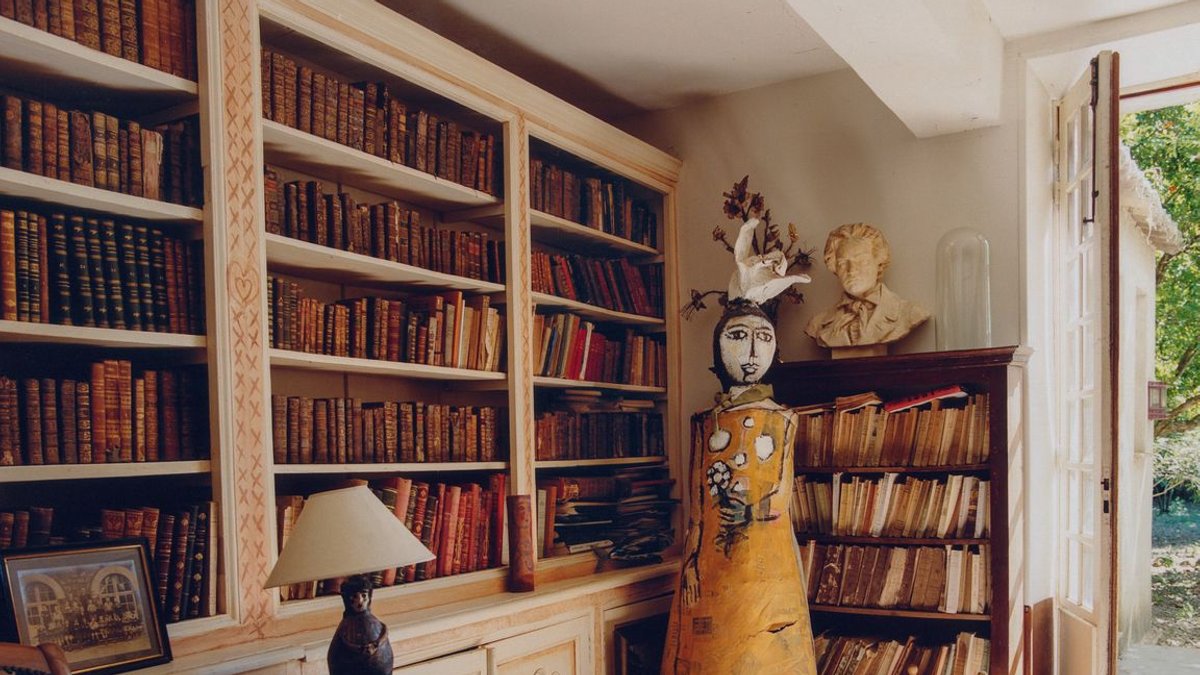
For 400 years, every generation of Lydia Corbett’s family has lived, dined, played and slept at Maison Latour, a spacious seven-bedroom Provençal mas in the south of France. The French painter and ceramicist – better known as Sylvette David, or ‘the girl with the ponytail’, who modelled for Picasso in 1954 (WoI Nov 2016) – has left her own indelible touch on the house. ‘It’s full of art – it’s a bit messy!’ the 92-year-old artist says over a cup of tea and pastries. She has long since swapped the high ponytail that features so prominently in Picasso’s portraits for two shoulder-length braids. As ever, the self-effacing Corbett is being too modest – the farmhouse, which retains many of its original features, is a sign to her own free-wheeling creative eye and to the generations of artists in her family. Over the years, she has covered it with luminous murals of angels, saints, flowers, animals and pilgrims. ‘I loved Charleston,’ she says of a visit to the farmhouse where Vanessa Bell and Duncan Grant lived. ‘It inspired me to paint on the walls. Actually, I tried to take the wallpaper off and couldn’t – so what I did is paint people on it.’ Corbett’s French father was a solicitor who became an art dealer, and her English mother was a painter. Their collection, including their own works and several canvases by Dany Lartigue, who lived in Saint-Tropez, adorns the walls alongside Lydia’s own pieces. One nude by her mother depicting Corbett’s godmother hangs in what was her grandmother’s bedroom above an antique metal cot. The three-storey stone house perched near an old silkworm farm has weathered the upheavals of French history. During the Revolution, the third floor was used to hide monks from religious persecution, and in the neighbouring city of Orange, Corbett’s great-grandfather was guillotined. When Hitler invaded France in World War II, the house was seized and used by German soldiers. (Mamiche, Corbett’s grandmother, was living there at the time and was forced to take care of them. Apparently they treated her surprisingly well.) Now it plays host to the clan every summer and an ever-expanding cast of friends, many of whom work in the creative arts. Both of Corbett’s adult daughters are painters, and the family continues the cultural heritage of Maison Latour by hosting artists’ retreats at the house. When her parents divorced, the teenage Lydia followed her mother to Vallauris, a seaside town on the French Riviera that had become a sanctuary for artists. Here she met Picasso, who was ‘very amusing’, she recalls. ‘He tried to make me laugh but I was shy – very serious, I was! He never flirted with me. I wouldn’t have had it – I already had a boyfriend.’ She started her artistic career in Vallauris, but put it to one side when she started a family and only picked it up again at 45 when her children had flown the nest. ‘I was able to just paint,’ she says. ‘I like staying at home. I’m not an adventurer!’ The house overlooks a garden shaded by a huge plane tree, planted when the family first moved in. Buttercream-yellow shutters – a style traditional to Provence – are often flung open to let the dappled light in through the windows, still with their original glass. Corbett has channelled her energy into remaking the house in a vision that is inimitably hers – a blend of female-centred spirituality, Christian iconography and nature. It is evident from the moment you push open the heavy teal front doors to reveal a mural of Saint Francis and his follower Saint Clare, each with a cat curled up at their feet. ‘I love all religions,’ the painter says with a smile. The mas extends from that central corridor on both sides, with a kitchen, formal and informal dining rooms on the right side and a studio, a library and the sitting room on the other. Adorning every shelf and surface are makeshift shrines and objets d’art passed down through the family or collected by the owner and her children from flea markets and vide-greniers (t)
Related: Rare Iris Blooms in Local Garden


