
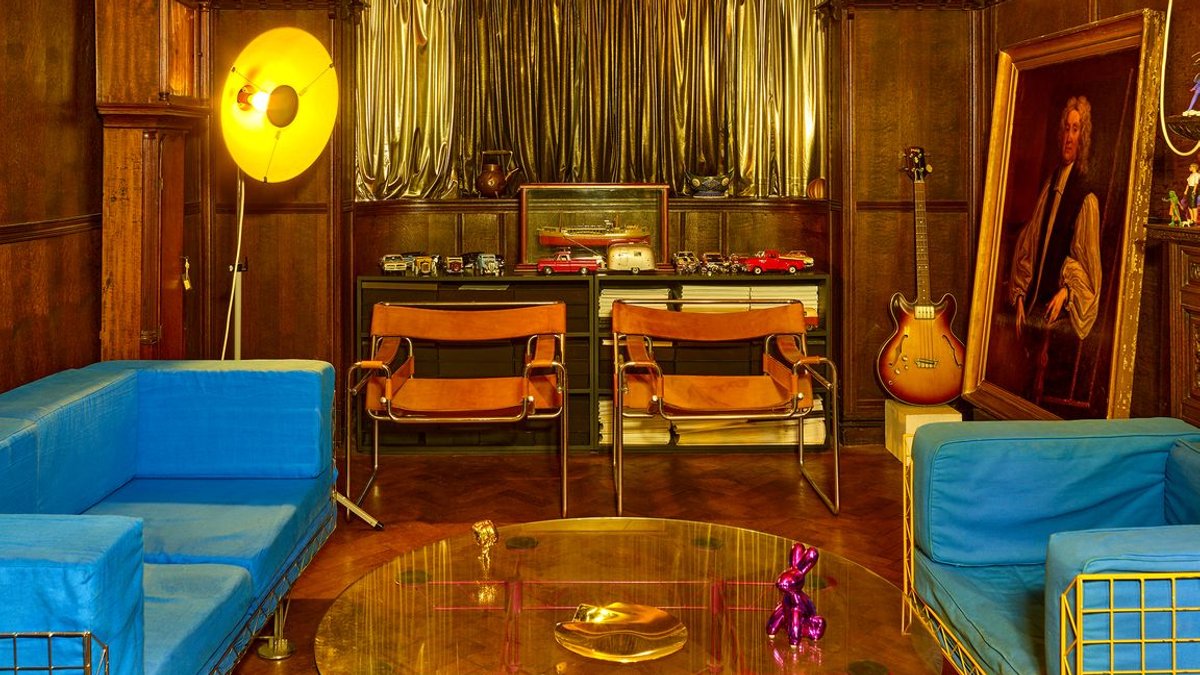
Andrew Holmes’ London home functions as a live-in studio. Behind him, crates hold remnants of his recent exhibition, Road Work, at the Architectural Association. One piece is bound for Berlin; another has already sold. “The house really is a kind of studio in which I live,” he says.
The table that rearranges itself
The writing room where the conversation takes place centers on a two-toned MDF table—half red, half blue—that shifts into different shapes. Its twin sits upstairs in what Holmes calls the drawing room. At the moment, the table forms a square, its edges framing images from the AA show. The arrangement serves a purpose, yet it also makes a point: nothing here stays fixed.
That adaptability defines the house itself. Holmes, an architect and artist in his seventies, designed much of the furniture with a local carpenter he knows only as “Mr Bird.” The partnership went beyond craftsmanship. “It’s also about knowing someone who can get the job done,” he explains. The front door handle sits so high visitors must stretch to reach it. The ceilings rise tall. The house, like his work, accommodates people—not just their bodies, but how they move through space.
Both/and, not either/or
Holmes’ work defies simple labels. His Polaroids of American cars—1972 Oldsmobile Delta 88 Royale and 1973 Chevrolet Impala, both shot in 1985—appear straightforward in their framing, yet they carry an undercurrent of depth. The camera’s direct angle captures more than the vehicles; it records the open spaces surrounding them and the weight of the sky. This contrast traces back to two paintings he saw side by side at the Museum of Modern Art: Edward Hopper’s hyper-realistic Gas (1940) and Agnes Martin’s minimalist ink drawing Stone (1964).
Related: Satoshi Kondo revives Miyake plastic bustiers in washi
Holmes finds both equally moving, though in different ways. He wondered if he could merge those feelings—realism with a sense of freedom. His Gas Tank Series, a set of hyper-realist drawings, adopts Hopper’s precision while reflecting Martin’s meditative repetition. The outcome feels strikingly present, almost too real, yet edges toward abstraction.
This approach solidified during a day he spent with composer John Cage. Instead of lecturing, Cage discussed his interests and answered questions. One idea stood out: the rejection of binary choices. The principle appears throughout Holmes’ work, from his furniture designs to his photographs of empty roads. Even his Polaroids, nearly perfect squares, are deliberately off by two millimeters.
Los Angeles holds a strong place in his imagination. He admires the city’s cloudless skies and how the light fades by 11 a.m. The white walls of his writing room—stripped of floral wallpaper one Christmas Eve—echo that openness. Upstairs, he works on a new series: “day for night” images of a Fresno house, named after Bunyan’s Pilgrim’s Progress. The monochrome sketches, paired with their color originals, evoke film noir with stark shadows and impossible angles. “I’m struggling with the ground right now,” he admits, though the challenge seems intentional.
The grease in the machine
Holmes’ home resembles a cabinet of curiosities. A mantelpiece displays figurines—Mickey Mouse, Batman, The Rock—while a stack of film noir DVDs sits nearby. Musical instruments lean against the walls. The clutter isn’t arbitrary; it reflects what engages him. He speaks of the “wrong note” in music, the human imperfection that makes a performance feel alive. The same quality resonates in Tina Turner’s words: “It ain’t no good if it ain’t got grease.”
Related: New Culinary Pavilion Opens at Bandon Dunes
That quality permeates his work. The Polaroids are almost—but not quite—perfect squares. The front gate is designed to be “as not there as possible,” a barrier that doesn’t truly block. His drawing process remains analog: 0.28-repeat graph paper, tracing paper, and an old-fashioned parallel motion. “A computer draws with light,” he says. “I want the physical presence of the object.”
Despite his precision, Holmes’ work thrives on what resists definition. His photographs of gas stations and truck stops lack people, yet they feel personal, like spaces awaiting occupation. The absence isn’t emptiness; it’s an opening. The same applies to his house—a place where art, architecture, and life merge into something deliberate yet unrestrained.
His approach to design extends beyond his home. A London duo’s urban cottage recently entered the rental market, offering a similar blend of functionality and creative expression.


